


OMIM ID:
Duane Retraction Syndrome 1
Alternate Names
Defective Genes
Clinical Characteristics
Ocular Features
Duane retraction syndrome is a clinically and genetically heterogeneous condition with a highly variable phenotype. Most cases occur sporadically but others are familial and about 30% of affected individuals have other congenital anomalies. It is also seen as part of other syndromes such as Goldenhar (164210), and Wildervanck (314600). In the absence of other anomalies, it is called isolated Duane syndrome. In addition, three types with autosomal dominant inheritance have been defined. The clinical features are highly variable making distinction difficult. Intrafamilial variation may be less than interfamilial differences. Patients with type 1 discussed here are more likely to have esotropia with a head turn to the involved side in unilateral cases whereas those with type 2 are considered more likely to have an exotropia with a head turn toward the uninvolved side.
This is a congenital and non-progressive strabismus syndrome. Sporadic cases are mostly unilateral while familial ones are more likely to be bilateral. The essential features are globe retraction upon adduction with narrowing of the lid fissure, and some limitation of abduction. Vertical deviation during adduction is sometimes seen. Frank strabismus in primary position is evident in as many as 76% of individuals and a compensatory head turn is often adopted but amblyopia still occurs in at least 10% of individuals. Females are affected more frequently than males.
At one point the syndrome was considered to be a myopathic disorder based on histologic changes in the lateral rectus but current thought based on MRI and neurohistologic studies favors a neuropathic etiology. The abducens motor neurons and the sixth nerve may be absent or dysplastic. Branches of the third nerve may also co-innervate the lateral and medial rectus muscles. EMG studies have documented simultaneous activation of the two muscles which likely accounts for at least some of the globe retraction. However, hypoplastic muscles, including the superior oblique, superior rectus, and levator, have also been visualized on MRI.
Systemic Features
None.
Genetics
Inheritance
Duane syndrome 1 described here follows an autosomal dominant pattern. No specific mutant gene has been found but a locus has been identified at 8q13.
Individuals having Duane Retraction Syndrome 2 (DURS2) (604356) are often found in autosomal dominant pedigrees also. Multiple mutations in CHN1 have been found among such individuals. Pedigrees consistent with autosomal recessive inheritance have also been reported but the responsible genes are unknown. Duane Retraction Syndrome (DURS3) (617041) patients with mutations in MAFB may have sensorineural hearing loss.
Features of Duane syndrome are also part of the Duane-Radial Ray Syndrome (607323).
Pedigree
Autosomal dominant
Autosomal dominant disorders require only one mutation for the disease to be expressed. Since an affected parent has two chromosomes, only one of which has the mutant gene, parents can expect that half (50%) of their children will receive that one and inherit the disease. It is common for individuals that inherit the mutation, however, to not have evidence of the disease (nonpenetrance).
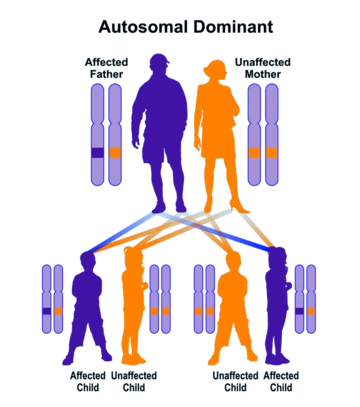
Autosomal dominant inheritance leads to a vertical pattern of transmission